

LLMs are everywhere in engineering right now.
Most of what gets called AI in mechanical engineering today is doing something fundamentally shallow. It reads text about your design without actually understanding it.
That distinction is the difference between a chatbot bolted onto your workflow and an agentic layer that lives inside it.
What Standard AI Actually Does With Your Designs
The typical AI integration in mechanical engineering works by running OCR across a 2D drawing to extract text and dimensions, passing that extracted text to a general-purpose LLM, and returning suggestions based on the text alone. The problem is that everything meaningful about a mechanical design is lost in that pipeline. The geometry, the tolerance stack-up, the version history, the approval state, the manufacturing context, all of it is invisible to the model. What you get back is a plausible-sounding response that has no idea whether the part can actually be machined, whether it fits inside the parent assembly, or whether the engineer already rejected this exact change two revisions ago. For mechanical engineering, that is not good enough. Hardware is unforgiving, and a missed tolerance does not cause a bug you can revert, It causes scrap, rework, and lead time delays that cost real money.
What an Agentic Layer Does Differently
bananaz was built on the premise that AI for mechanical engineering has to start with the data mechanical engineers actually use. Not a text extract of the drawing, but the drawing itself, the 3D model itself, the assembly, the BOM, the revision history, and the PDM workflow states.
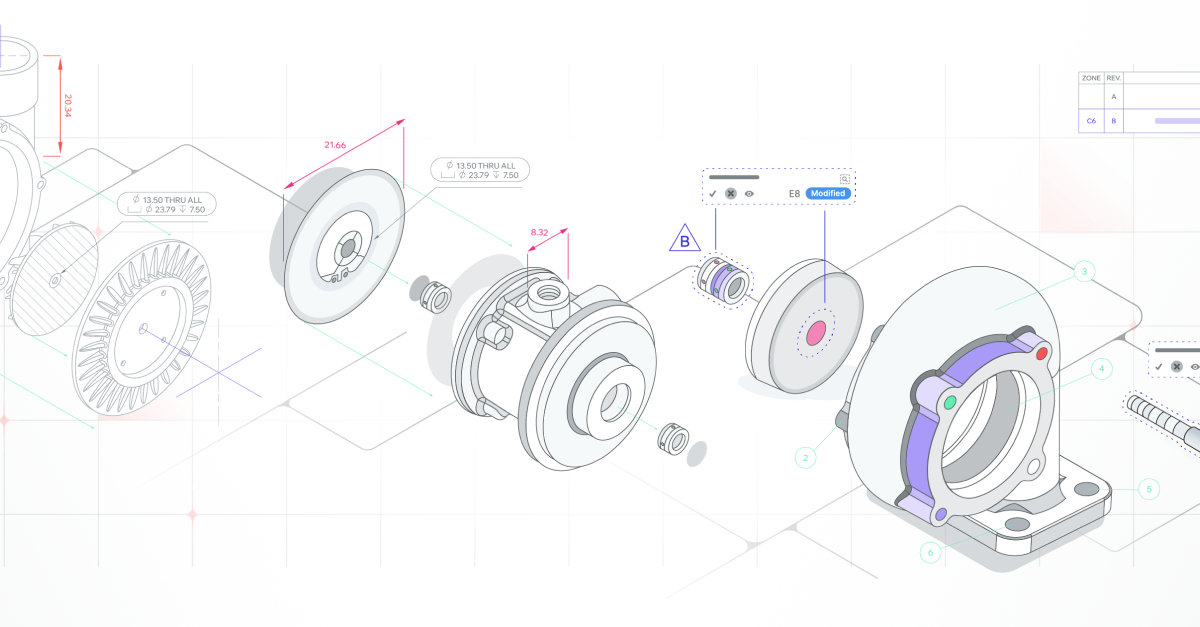
That is what makes bananaz an agentic layer rather than a chatbot. It sits on top of your existing CAD and PLM environment and operates on native engineering data directly. bananaz parses native CAD files, reads embedded metadata across 2D drawings, 3D models, and BOMs, integrates with your PDM and PLM to understand version history and assembly relationships, and runs autonomous agents that enforce your design and manufacturing rules in real time.
Standard AI waits for you to ask it something, but agents do not wait. Once deployed, they continuously enforce the rules you care about, flag risks before they reach review, and run analysis as a native part of your workflow instead of as a separate step you have to remember to trigger.
Why This Distinction Matters in Practice
The difference between generic AI and an agentic layer shows up the moment a real engineering question comes up.
Ask a standard LLM whether a change between two revisions affects manufacturability and it will guess, because it has no access to the actual geometry or to the company-specific rules that define "manufacturable" in your context. Ask bananaz the same thing and it compares the two 3D models directly, identifies the geometric changes in space, and checks them against your active ruleset. One gives you a generic answer, the other gives you a decision you can act on.
This is the shift from AI that assists with individual prompts to AI that operates inside your workflow.
Why It Matters
The teams getting real value from AI in engineering right now are not the ones with the most chatbots. They are the ones whose AI actually operates inside their workflow, on their real data, and against their real rules.
That is what an agentic layer means, and it is why bananaz works where generic AI falls short.
Want to see the agentic layer in action on your own designs? Book a demo with one of our AI consultants.
.png)
.png)

