In a world where "AI for Mechanical Engineering" is the new standard, the question has shifted from if you should use it, to which tool you can actually trust with your GD&T and 3D models.
In a recent study we pitted the four heavyweights: Gemini 3 Pro, ChatGPT 5.1 Pro, Claude Opus 4.5, and Grok 4.1, against each other in a rigorous series of tests covering theoretical questions, drawing reviews, and DFM analysis.
One important takeaway: Even the best-performing model in this study occasionally produced confident but incorrect engineering conclusions, underscoring why LLMs should not be treated as decision-makers.
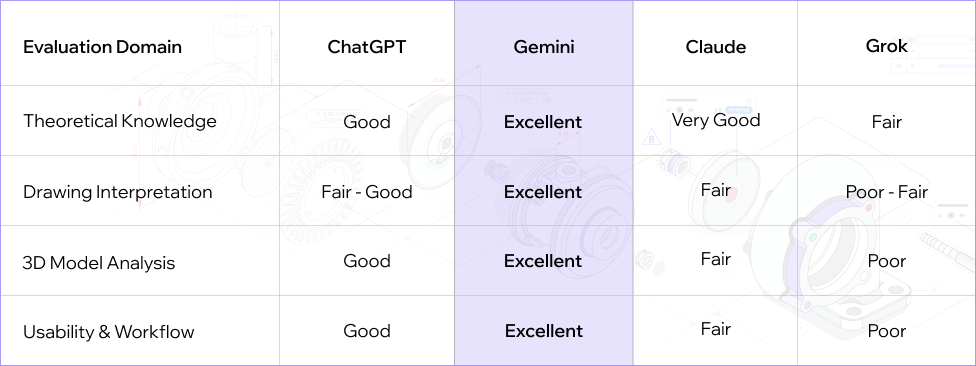
Here is how they stack up for mechanical engineering workflows in 2026:
The Champion: Gemini (Version 3 Pro)
The Verdict: The most capable model tested, demonstrating the strongest grasp of engineering logic.
- Why it won: Gemini outperformed the field in 3D DFM analysis and technical drawing interpretation. It provided the most coherent explanations for geometric issues and suggested realistic fixes.
- Best for: High-level design critique when all conclusions are independently verified.
The Runner-Up: ChatGPT (Version 5.1 Pro)
The Verdict: A capable assistant that requires a watchful eye.
- Performance: ChatGPT remains a robust all-rounder with strong theoretical knowledge. However, it proved less stable than Gemini, often requiring explicit "prompt engineering" to understand geometric intent.
- Best for: Brainstorming, and broad theoretical questions.
The Specialist: Claude (Version Opus 4.5)
The Verdict: Brilliant but overly concise.
- Performance: Claude showed high intelligence and strong numerical reasoning but failed on usability for engineers. Its tendency to be overly brief meant it often omitted critical engineering context or safety warnings, making it risky for decision-support.
- Best for: Quick numerical checks (if you verify the context and double check).
Not Recommended: Grok (Version 4.1)
The Verdict: Not ready for production.
- Performance: Grok struggled significantly with engineering context, frequently hallucinating standards or "approving" designs with fatal flaws. It is currently too unreliable for precision engineering tasks.
The "Secret Sauce": It’s Not Just the Model
While Gemini took the crown in standalone testing, the study concludes that no LLM should be your sole decision-maker. To move from a "chatbot" to a verifiable AI for Mechanical Engineering, the AI must be embedded in a system that understands the raw data of our world: CAD geometry, design history, and manufacturability rules.
The Takeaway:
- For a quick chat? Use Gemini 3 Pro.
- For real engineering work? Use a platform like bananaz. Built on mechanical logic, it combines multiple technologies and integrates directly with your CAD, PDM, and PLM. This allows it to act as a true assistant - analyzing broader context to provide valuable insights and automating the tedious work, helping you move faster while keeping you in control.